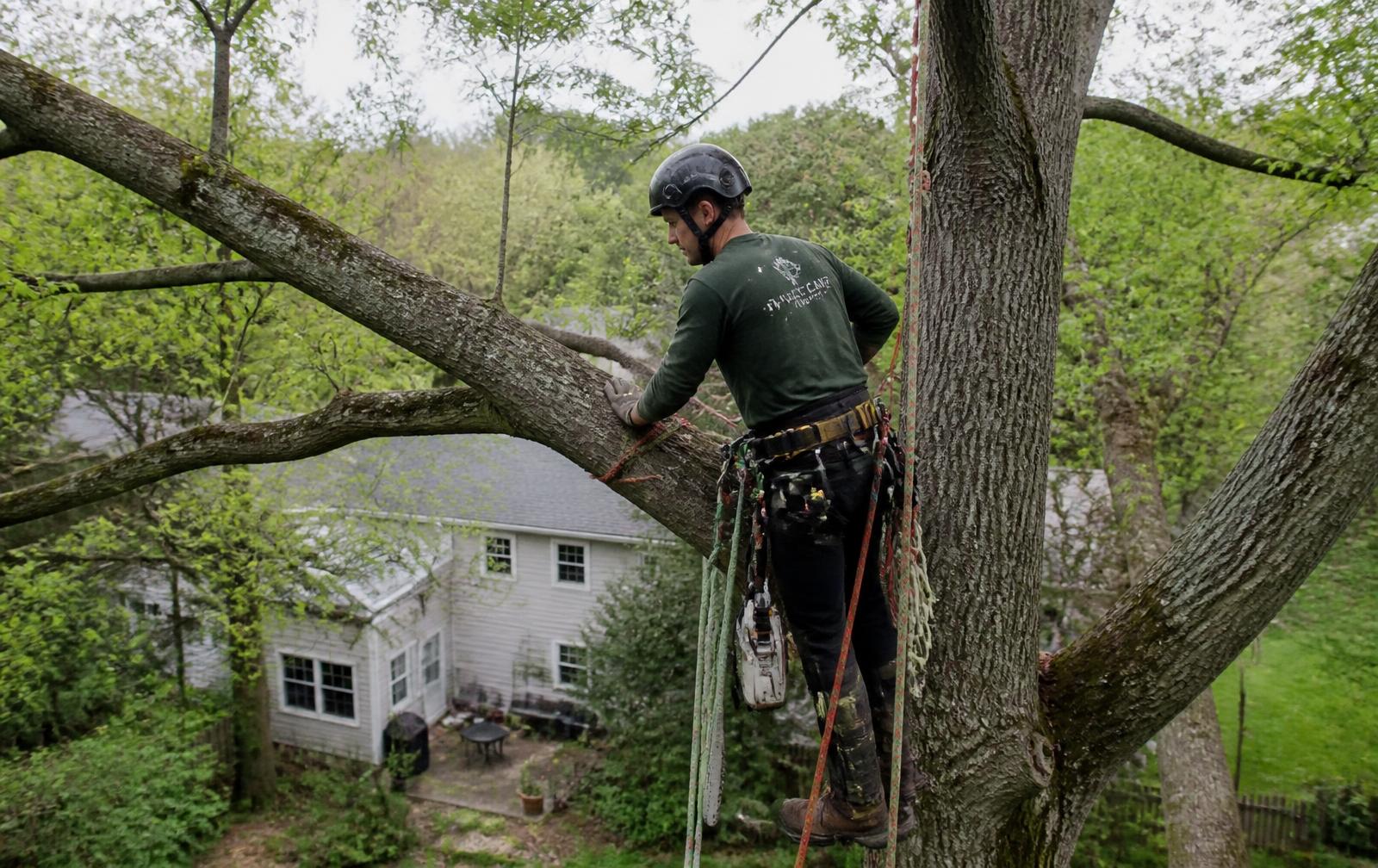
Tree Removal in Whitby
Whitby runs from the heritage streets around downtown up to Brooklin's newer estates, and each end brings a different kind of tree job. Tell us what you're dealing with and we'll help connect you with a local tree professional.
Heritage trees downtown, wind exposure up north
The blocks around Dundas and Brock hold some genuinely old trees — big oaks and maples with real value, where pruning or cabling is often the better answer than removal. Homeowners there frequently want an arborist opinion before they commit to taking anything down, and that's a reasonable instinct.
Brooklin and the north Whitby subdivisions sit higher and more exposed. Trees planted at the same time in the same soil tend to fail at the same time, which is why one windy night can put half a street on the phone at once.
Lynde Creek and ravine lots
Properties backing onto Lynde Creek, Pringle Creek or the Whitby ravine system can have conservation authority regulations layered on top of the Town's rules, and steep-bank access changes how equipment gets in. Mention it in your request if your tree is on a slope or near the ravine edge.
Tree removal services for Whitby homeowners
Most tree removal requests in Whitby start with a tree that has changed — something that looked fine for years and now doesn't. The most common reasons homeowners reach out are dead or dying trees (often ash that never recovered from emerald ash borer), dangerous or unstable trees showing lean, splits or heaving soil, and storm-damaged trees that lost major limbs or partially failed in high wind.
A tree removal service is also the right call for fallen trees already down on a lawn, driveway, fence or roof, for large damaged branches hanging over areas people use, and for trees that have grown to threaten homes, garages, fences or other structures. Sometimes the driver is simpler: a tree is interfering with an addition, a pool, a new fence line or other property improvements, or an arborist assessment has already concluded that removal is the sensible option.
Whatever the situation, describe it plainly when you submit your request — what the tree is, what changed, and what it's near. That's what a local tree professional needs to respond usefully.
Emergency tree removal in Whitby
Urgent tree problems tend to look the same everywhere: a fallen tree across a driveway or onto a structure, a tree damaged during a storm with large hanging or broken branches still overhead, a tree newly leaning toward a house or garage, or a tree blocking access to the property entirely. Any tree that appears unstable after a storm deserves caution.
If you're dealing with one of these situations, keep people and pets away from the area and avoid approaching an unstable tree unnecessarily — partially failed trees and hung-up branches can move without warning. If wires are involved, contact the utility first and stay well back. Then describe the situation when you submit your request: what fell or shifted, what it's touching, and whether anyone is blocked in. Photos from a safe distance help a lot.
Our emergency tree removal page explains how urgent requests are handled. Tell us what happened and we'll work on connecting you with a local tree professional.
Urgent tree problem in Whitby? Send the details once — photos help — and we'll work on getting it in front of a local professional.
Tree removal in Brooklin
Brooklin's tree work has its own texture. Many properties are newer estates where fast-growing shade trees were planted close to the house, and a tree that suited the lot at planting can now be crowding roofs, eavestroughs and fences. Trees near overhead utility lines and service drops are common on some Brooklin streets, and work near lines may require specialized handling or coordination with the utility.
Because Brooklin sits higher and more open than south Whitby, storm damage can be a factor after strong wind events, and equipment access — side gates, corner lots, proximity to neighbouring homes — can shape how a removal is approached. Some trees may benefit from an assessment before removal, particularly where the tree's condition is uncertain. Mention any of these details in your request and a local professional can advise on what applies to your property.
Areas covered in Whitby
- Downtown Whitby
- Brooklin
- Pringle Creek
- Rolling Acres
- Williamsburg
- Blue Grass Meadows
- Port Whitby
- Lynde Creek
Local rules worth knowing
- Whitby has tree protection provisions that can apply to larger trees and to trees on Town property.
- Ravine and creek-adjacent lots may involve Central Lake Ontario Conservation Authority approvals.
- Brooklin's newer streets often have overhead service drops close to fast-growing shade trees.
General information only — confirm requirements with Town of Whitby or the professional who contacts you.
Tree removal permits and regulations in Whitby
Depending on the property and location, tree removal may require a permit or approval. Whether one applies can depend on the tree, the lot and who has jurisdiction over the land. Requirements can apply to areas such as:
- Certain woodlots, which can fall under Regional woodlot conservation rules
- Environmentally protected or conservation areas, including regulated ravine and creek lands
- Designated heritage districts, where additional review can apply
- Certain larger residential or rural properties
- Areas subject to tree preservation plans connected to development or site plans
- Properties where Durham Region or another agency has jurisdiction over the land or the tree
Homeowners should confirm current requirements before removing a tree — the professional who contacts you can usually tell you when a permit question applies, and the Town publishes its rules publicly. See the Town of Whitby's tree policies and by-laws for the current details.
Does the tree actually need to be removed?
Not always. Removal is the right answer in some situations, but a mature Whitby tree — especially one of the big oaks and maples around downtown — can sometimes be a better candidate for assessment or preservation than for automatic removal. Deadwood removal, crown reduction, structural pruning, cabling or ongoing maintenance can address a specific concern while keeping a sound tree standing.
Removal tends to enter the conversation when a tree is dead, significantly compromised, structurally unsafe, or otherwise presents an unacceptable risk to people or property — or when it simply cannot coexist with what the property needs. Only a qualified assessment on site can say which side of that line your tree is on. If you're unsure, an arborist assessment is a reasonable first step rather than a commitment to removal.
How tree removal works
- 1
Tell us about the tree problem
Describe what the tree is, what changed and what it's near — a house, wires, a fence, a driveway.
- 2
Provide photos if available
Photos from a safe distance help a professional understand the size, condition and setting before anyone visits.
- 3
A local tree professional reviews the request
Your details are passed to a tree professional serving Whitby who can respond to your specific situation.
- 4
An on-site assessment can be arranged when appropriate
Many tree questions can only be answered properly by looking at the tree, the access and the surroundings in person.
- 5
The professional discusses the recommended work and next steps
You'll hear what they recommend, what it involves, and what happens next — the decision is always yours.
Ready when you are — send the details of your Whitby tree problem and we'll work on connecting you with a local professional.
Related Whitby tree services
Dealing with something specific? These pages go deeper:
Tree services in Whitby
Tree removal in Whitby — FAQs
Is tree removal in Brooklin different from south Whitby?
Usually in access and exposure rather than in principle. Brooklin lots are newer and more open, but they sit higher and take more wind, and the trees are often fast-growing shade trees planted close to the house at the same time as the subdivision — so storm damage and crowding of roofs and fences are common themes. South Whitby has older, larger trees in tighter spaces close to heritage homes, where rigging, sectional dismantling and protecting what's around the tree matter most. In both cases, access for equipment and proximity to structures or overhead lines shape the job.
My tree backs onto the Lynde Creek ravine. Does that matter?
It can. Properties backing onto Lynde Creek, Pringle Creek or the Whitby ravine system may fall within areas regulated by the conservation authority, which can add an approval step before certain tree work. Steep-bank access also changes how equipment and debris are handled. Mention the ravine when you submit your request — a local professional who works in Whitby regularly will know when conservation authority rules are likely to apply and can advise on the process before any work is scheduled.
Can a big old Whitby tree be saved instead of removed?
Often, yes — and it's a fair question to ask before committing to removal. Mature oaks and maples around downtown Whitby can have real value, and options like deadwood removal, crown reduction, structural pruning or cabling can address a specific concern while keeping a sound tree standing. Removal generally enters the picture when a tree is dead, significantly compromised or structurally unsafe. An arborist assessment is what tells you which side of that line your tree is on.
Do I need a permit to remove a tree in Whitby?
Depending on the property and location, tree removal may require a permit or approval. Requirements can apply to certain woodlots, environmentally protected or conservation areas, designated heritage districts, certain larger residential or rural properties, areas subject to tree preservation plans, and properties where Durham Region or another agency has jurisdiction. Homeowners should confirm current requirements before removing a tree — the Town of Whitby publishes its tree policies and by-laws, and the professional who contacts you can usually flag when a permit question applies.
How much does tree removal cost in Whitby?
There's no single honest number. Pricing can vary substantially depending on the tree's size, its location on the property, access for equipment, the tree's condition, and the complexity of the work — a small open-lot removal and a large sectional dismantle over a house are very different jobs. An on-site assessment is usually needed for an accurate estimate, which is one reason photos and access details in your request are so helpful.
What should I do if a tree falls during a storm?
Keep people and pets well away from it — partially failed trees and hung-up branches can shift without warning, and avoid approaching an unstable tree unnecessarily. If wires are involved or the tree is near power lines, contact the utility first and stay back. Photograph the damage from a safe distance for your insurer, then submit the details of what happened with your photos. Tell us what happened and we'll work on connecting you with a local tree professional.
Can a tree be assessed before deciding to remove it?
Yes — and for mature Whitby trees it's often a sensible first step. An arborist assessment can tell you whether a tree is dead, compromised or structurally unsafe, or whether pruning, cabling or maintenance could address the concern instead. An assessment is advice, not a commitment to removal, and it gives you a defensible basis for whatever you decide next.
Can a tree near hydro wires be removed?
Trees near utility lines may require specialized professional handling, and utility involvement may be appropriate depending on the situation. Never attempt to cut or prune a tree near wires yourself — electricity can arc without direct contact, and lines under tension from a fallen tree are especially dangerous. If a tree is touching or has brought down a line, contact the utility first, keep everyone away, and note the wires in your request so the responding professional knows exactly what they're walking into.
Who is responsible for a tree on Town property?
Trees on Town property — including many boulevard trees between the sidewalk and the curb — are the Town's responsibility, and homeowners should not assume they are responsible for removing them or arrange private removal of a Town tree. If you're unsure whether a tree is yours or the Town's, confirm ownership and any requirements with the Town of Whitby before doing anything. Property-line trees can also involve shared ownership questions worth clarifying first.
Do ravine or creek-adjacent properties have additional requirements?
They can. Properties backing onto Lynde Creek, Pringle Creek or the wider Whitby ravine system may fall within regulated areas where the conservation authority's rules apply alongside the Town's, and that can add an approval step before certain tree work. It isn't automatic for every creekside property, which is why it's worth mentioning in your request — a local professional can advise on what applies to your specific lot before work is scheduled.
Nearby Durham municipalities
Tree Removal Oshawa
From the mature canopy around McLaughlin and O'Neill to the newer builds north of Taunton,…
Tree Removal Ajax
Ajax takes the wind straight off Lake Ontario, and south-end properties feel it first. Whe…
Tree Removal Scugog
Between Port Perry's older village lots and the exposed shoreline around Lake Scugog, tree…